
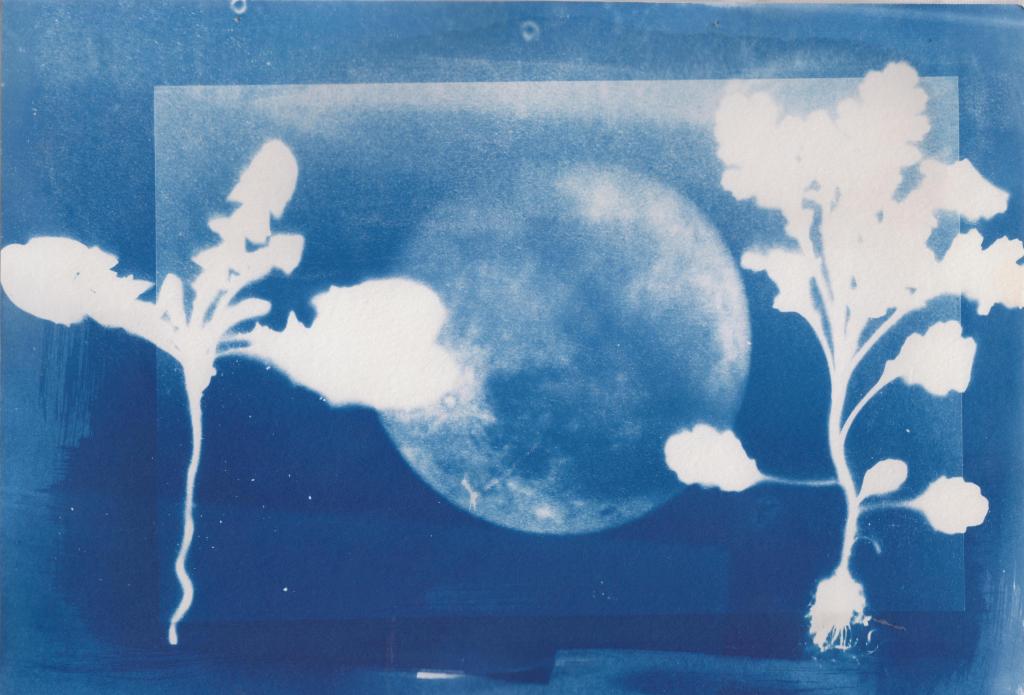
Carbon does not speak, calcium does not remember, iron does not weep.
Loren Eiseley, The Night Country
Previously …
It was air that created gigantism, I learnt recently – a massive oxygen spike billions of years ago – that in time enabled dragon flies to achieve wing spans of twenty-eight inches, and trees to grow tall with the structural support of a new bark-building molecule, lignin. In a lag of co-evolution, the bacteria of the day could not yet digest this, and so the trees’ carbon became buried beneath the swamps for several hundred million years, where it remained until it was disinterred to fuel the first Industrial Revolution, roughly considered to have taken place, in Britain, between 1760 and 1830.
If air were invited to tell their story, they would be surprised. Then they would employ no conventional narrative devices, no arcs, no in medias res, no plots; characters would be so numerous as to be meaningless, there would be no metaphors, punchlines or resolution and they would not be invited again. They do not know that timing is everything, because they are space.
If, as the late inspirational geographer, Doreen Massey, proposed, space is always under construction, never finished or closed, a product of relations-between, from the global to the intimate, a simultaneity of stories-so far, she could have chosen the London Borough of Newham as an ideal case study.
Time though would insist on the importance of the trusted line in such a case. They would highlight key dates, such as the 1844’s Metropolitan Building Act when noxious industries were banished eastward. They would mention the rise and fall of the docks, trading at first in goods harvested by enslaved individuals, then feeding and fuelling Britain in its heyday as colonial superpower. They would point out the Great Smog of 1952 and then explain in too much detail that when poisonous gases and particles are expelled into the atmosphere, they act as catalysts for polluted fog and foul-smelling yellow or brown smog because water clings to the tiny particles. Both time and space would emphasise co-production, the mixture of chemicals, water, and air becoming acid, and then corroding buildings, irritating skin, and attacking the lungs which in mammals like us house hundreds of millions of bubble-like structures, the alveoli.
This was the smog my mother talked about, so dense that it took her hours to find her way home from work, and when she arrived, the exposed edge of her petticoat was black.
The lungs are neither open nor closed; secluded in the body, they are nevertheless the body’s form of exposure to its outside, a way of creating a field of openness within its own compass.
Steven Connor, The Matter of Air
The acceptance of East London as a site of toxicity prevails but the main insult to the quality of air in Newham today arises not from coal fires and factories, but from road traffic. Exposure to air pollution is recognised as a leading risk factor for human health, and attempts to control emissions exist: in London, the low emission and the ultra-low emission zones. However, concentrations of atmospheric pollutants such as Nitrogen dioxide, NO2 still exceed the annual mean Euro limit. In East London, hospitalisation for asthma generally is 14% higher than the London average, and asthma related to road traffic air pollution burdens children. One child’s death is of particular significance and was brought to the attention of the media and medical community in late 2020.
I am Philip Barlow, assistant coroner for the coroner area of Inner South London.

On 17 December 2019 I re-opened an investigation into the death of Ella Adoo Kissi- Debrah. The investigation concluded at the end of the inquest on 16 December 2020. The conclusion of the inquest was:

Medical cause of death:
1a) Acute respiratory failure

1b) Severe asthma
1c) Air pollution exposure

Narrative conclusion:
Died of asthma contributed to by exposure to excessive air pollution.

CIRCUMSTANCES OF THE DEATH

Ella died at the age of 9. She had severe, hypersecretory asthma causing episodes of respiratory and cardiac arrest and requiring frequent emergency hospital admissions. On 15 February 2013 she had a further asthmatic episode at home and was taken to hospital where she suffered a cardiac arrest from which she could not be resuscitated.
In the time leading up to the re-investigation, and in the almost decade since Ella’s death, her mother, Rosamund, has campaigned on air quality, raising awareness of asthma. She is a World Health Organisation Advocate for health and air quality and has been centrally involved in the Stop the Silvertown Tunnel campaign. She was to speak at on online meeting in June 2021, alongside local GPs and respiratory health specialists and I helped to publicise it, joining a National Education Union member outside a local primary school which would see greatly increased heavy goods traffic from the tunnel.
The NEU member, in a leopard print dress I remember, had tried and failed to gain permission for this, but decided to go ahead anyway. So, we handed out our leaflets to mostly women, many pregnant or carrying infants. Children took them too, and the odd man reached out for one as they grasped the hand of their child at the pick-up. We told them about the tunnel, on-site preparations for which had begun. We asked how they felt about the increase in lorries thundering along the road near the school. I asked them if they had heard of Ella Kissi-Debrah and no-one had. No-one actually knew about the planned tunnel either. No-one from the school came out to talk to us, though we did step tentatively inside the gate to explain what we were doing. No interest was expressed. When I looked down at the playground surface I saw that someone had written in chalk: ‘We are desperate.’ I have no idea why or who, but as I walked home, on the other side of the road from the Sonia Boyce mural, with its frieze of wild flowers, half-tone images of houses, and quotes from local people, (some of which had been censored by the council – the blank panels), I thought how distant from decision-making many people were.
Many Stop The Silvertown Tunnel actions have taken place, including a health summit. A delegation of local doctors to City Hall, by then relocated to the heart of the site, presented a letter that said the tunnel would “funnel traffic, including heavy freight vehicles, into areas of deprivation which already suffer disproportionately from so many adverse social determinants of health.” In October 2020, a group of Newham XR members planted 26 silver birch trees on some nearby scrubland to commemorate the 26 lives lost every day from air pollution in London. In the evening, white shoes were placed beside the trees, photographed and then removed.
The tunnel construction is now well advanced and, according to Sian Berry, Green Assembly Member, the boring machine cannot now be reversed but must continue to the other side. In August she hosted an event in City Hall inviting children and family members to suggest alternative uses for the tunnel.
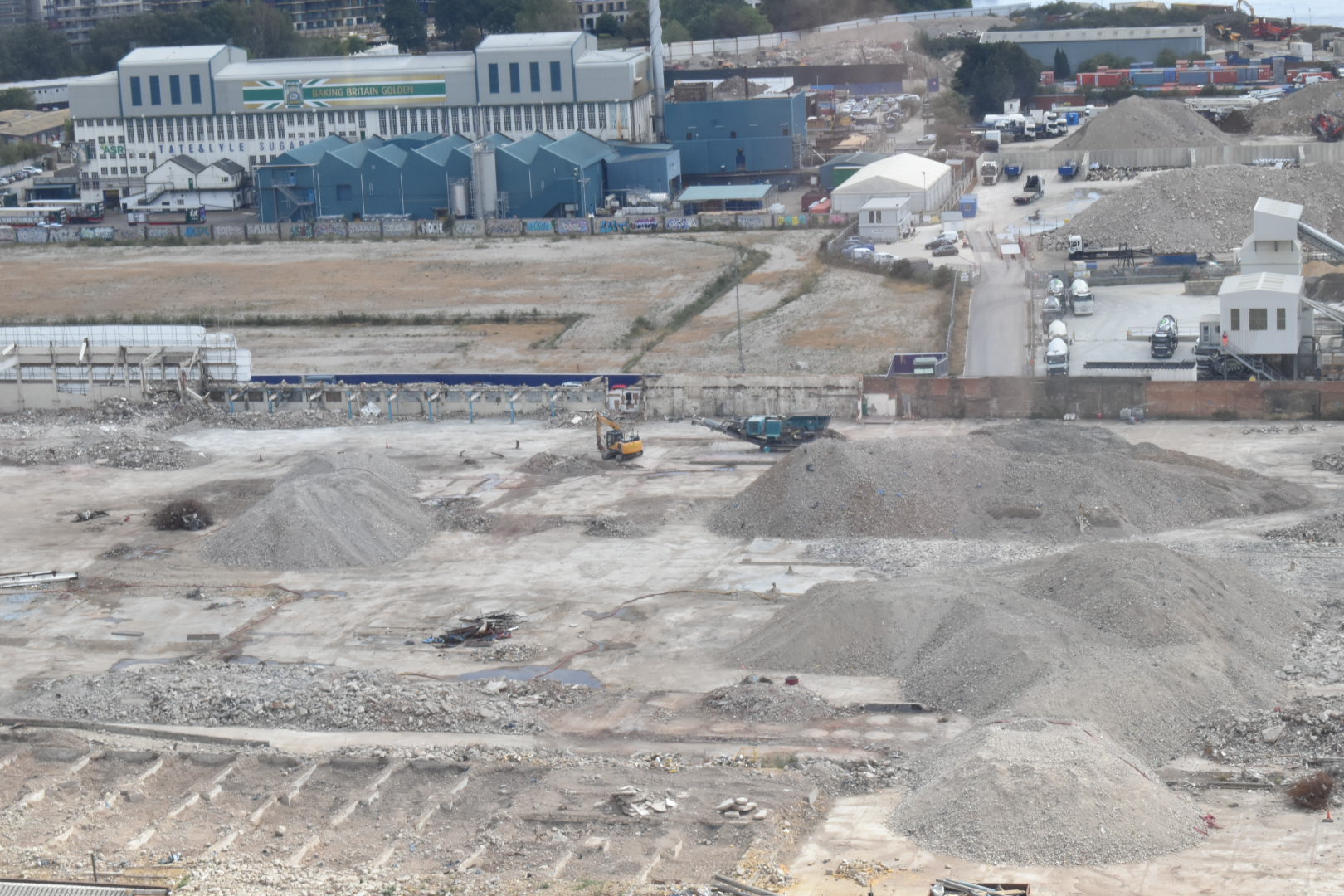
The Emirates cable car affords an aerial view of the tunnel excavation site and a few days ago I went up to have a look as I crossed. The site was too vast to take in, and none of my photographs could convey the entirety of the precise quarrying out taking place in the canyon below. Now, almost two years later I came to see if the trees were still alive, and in the manner of someone conducting a forensic search I went over the whole area, which seemed bigger when it was punctuated by bent figures with trowels. Although they seemed healthy enough when I last looked about a year ago, there was now no trace of the saplings, nor a shred of their protective cardboard. The rotting mattress I remembered was still there, but the birch trees, I concluded, had been thoroughly cleared. I photographed their absence, and in the process noticed that a wild cherry had seeded several new trees.
Then inside a nearby fence I spotted something of human scale: a table that could have been laid for a meal for one and a chair. I photographed them too. Within seconds, I was interrupted by a security guard, smartly dressed in a uniform, who seemed to appear from nowhere. You realise you are on camera, he told me. You have been photographing an entrance to the site. I must ask you to delete these pictures. I complied; the photograph wasn’t important. It was just that I had allowed myself to respond to place in time and space.
Reading
Peter Adey, Air, Nature and Culture, Reaktion Books, 2014.
Steven Connor, The Matter of Air, Science and Art of the Ethereal, Reaktion Books, 2010.
Richard Mabey, The Unofficial Countryside, Little Toller Books, 2010.
Hajar Majmohammadi et al, Association between short term NOx exposure and asthma exacerbations in East London: A time series regression model, Urban climate 44 (2022), Elsevier. Available online: https://doi.org/10.1016/j.uclim.2022.101173
Doreen Massey, For Space, Sage, 2005.


 THE LIBRARY SERVICE